originally published on the Sustainable House blog
Auburn Girls High School in NSW has completed a trial comparing six different compost designs. Carried out over 9 months, the trial compared designs for worm farm, rotating bins and other options suitable for schools, units, houses and offices.
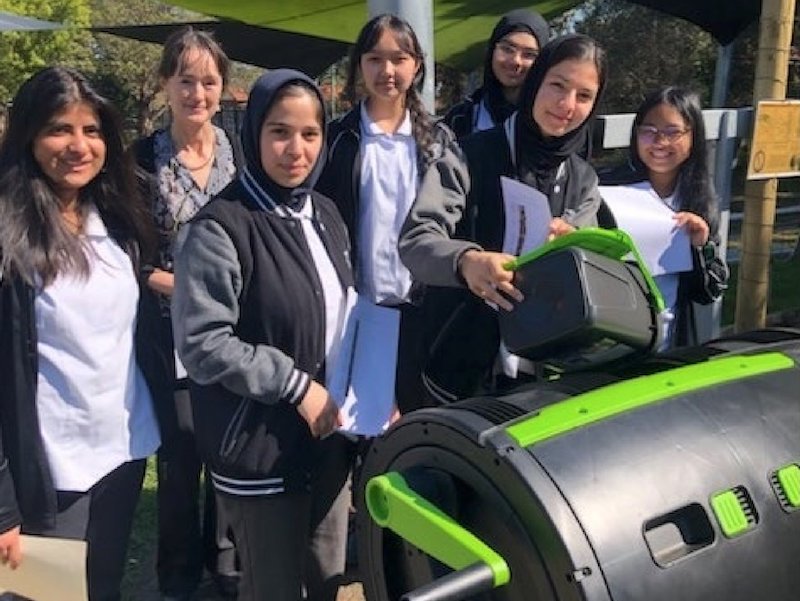
Food waste from the school canteen, teacher and students meals was weighed, and put into the compost bins to enable comparisons about user experience such as, ease of use, rate of compost, and maintenance requirements.
This project was possible with funding from the Sustainable Schools Grant program, through Schools Infrastructure NSW and the Department of Education. The report was compiled in a consultative process involving students, teachers and the School Librarian, Linda Park as the authors.
The report finds that:
“This trial results show it is possible for Australia’s public schools to save costs by reducing or ending food waste, which, in turn, reduces waste pickup fees. Extrapolating the results in general and rough terms, the range of cost savings across NSW public schools it is estimated by our calculations to be about $4 million dollars a year, assuming that there are about 795,485 students in NSW public schools, and 840 at Auburn Girl’s High School.
Since most public schools are underfunded, by finding financial savings within current school budgets through diverting food waste from general waste, schools may by their own initiatives divert monies saved from waste bills to other school running costs such as for teacher salaries, school assets, school property maintenance, and other presently un-met needs.”
Key recommendations:
- Every NSW school, including Auburn Girls High School, could this year increase the amount of food waste directed to the new or existing compost options with the goals of:
- Ending food waste from the school;
- Incorporating composting and related data into the maths, science, TAS and other curricula as is now being done increasingly across the NSW public school system;
- Reducing the school’s climate pollution;
- Reducing the school’s waste collection costs and freeing up those funding demands for re-deployment elsewhere in the schools’ operating budgets;
- Saving NSW public schools over $4 million each year.
And,
Auburn Girls High School and all NSW schools could in Term 2 collect and integrate the data from compost activities into TAS, Maths, Social Sciences, Science and other curricula content in the school
And,
The Department of Education could this current school term let all NSW schools know that schools finding financial savings within current school budgets through diverting food waste from general waste may, by their own initiatives, divert monies saved from waste bills to other school running costs such as for teacher salaries, school assets, school property maintenance, and other presently un-met needs.
Trial Acknowledgement
In a speech in the NSW Parliament praising the school the local state MP Lynda Voltz said:
The benefits of the project include savings on waste pick-up costs, benefits to children’s mental and physical health, increased environment health and an enhanced academic experience. Growing food also encourages students to eat more vegetables, and gardening can lower students’ cortisol levels and reduce stress, which helps improve their academic performance. More plants and trees, and an increase in growth and canopy rates on the school campus, can increase air quality, cool the school and reduce air-conditioning costs. The project also provided a valuable practical lesson on heat islands through practical examples such as measuring the heat of a road with a tree canopy shade against those without. For the information of the House, it was 26 degrees on a road with shade and 37 degrees on a road without a difference of over 10 degrees.”.
Read the full report here:
Leave a Reply