
- This event has passed.
NENA Post-Growth Futures Week (mulitiple dates) [online]
21 June @ 1:00 pm – 26 June @ 3:00 pm AEST
New Economy Network Australia
Sun, 21 Jun, 5pm – Fri, 26 Jun, 6pm AEST
June 21 — World Localisation Day, 6pmAEST
Supported by NENA’s Localisation Hub
Growing Deeper, Not Up: Building Local Futures Through Transition and Degrowth
What if the future of prosperity lies not in endless expansion, but in rebuilding strong local economies, resilient communities, and meaningful connections to place?
Launching on World Localisation Day, this opening session explores how localisation can help us rethink growth, progress, and prosperity in an age of ecological and social instability. Together, speakers from the localisation, transition, and degrowth movements will explore ideas such as “scaling out instead of up,” “growing roots instead of stuff,” and rebuilding economies grounded in care, sufficiency, resilience, and genuine wellbeing.
June 22, 1pm AEST
Supported by NENA’s Regenerative Business Hub
From Growth to Value: Finding the Entry Points for Business
How do we create meaningful change within businesses still deeply tied to growth, profit, and shareholder expectations?
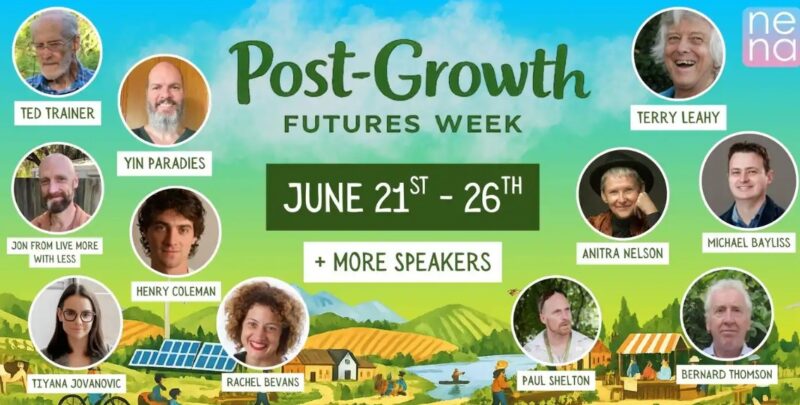
In this session, Rachel Bevans from The Regenerative Business Collective explores how organisations can shift the conversation from how much they grow to what value they create and for whom. Drawing on decades of experience working with medium and large businesses, Rachel will unpack practical entry points for moving from extraction to regeneration, overconsumption to sufficiency, and growth-driven models toward approaches grounded in stakeholder wellbeing, restoration, and long-term resilience.
June 23, 12pm AEST
Supported by NENA’s Degrowth Hub
Living Well With Less Money: Simplicity, Sufficiency, and Post-Growth Futures
What if living well didn’t depend on earning more, consuming more, or growing the economy forever?
This thought-provoking panel discussion explores practical and visionary pathways toward simpler, more resilient, and less money-dependent ways of living. Featuring Jon from Living More With Less, Ted Trainer discussing The Simpler Way and Pigface Point, and Anitra Nelson on nonmonetary futures and postcapitalist communities. The session concludes with a lively audience Q&A.
June 24, 12pm AEST
Supported by NENA’s Systems Change Hub
Measuring What Matters: Economic Progress Beyond Growth
How do we measure progress in a world facing ecological breakdown, rising inequality, and declining wellbeing?
This panel explores the limitations of GDP and growth-based economics, while examining alternative ways of understanding prosperity, wellbeing, resilience, and collective flourishing. Together, Tiyana Jovanovic, Bernard Thomson, and other speakers will unpack how economic metrics shape policy, culture, and public imagination—and what it might mean to truly measure what matters in a post-growth future.
June 25, 1pm AEST
Supported by NENA’s Economic Literacy Hub
Learning from ‘Pre-Growth’ Economies: Gift, Sharing, and Decolonised Futures
What can we learn from the ways humans organised societies before economies became dominated by perpetual growth and extraction?
This panel discussion explores gift economies, sharing economies, and Indigenous and decolonial perspectives on economic life. Featuring Yin Paradies on decolonising the economy in practice, Terry Leahy on the gift economy, and additional speakers exploring sharing economies and commoning, the session invites participants to rethink some of the deepest assumptions underpinning modern economic life.
June 26, 1pm AEST
Supported by NENA’s Storytelling Hub
A Day In The Life of a New Economy: Rekindling Our Imaginations
What if we could step inside a post-growth future and experience what everyday life might actually feel like?
In this interactive workshop, Michael Bayliss, host of the Post Growth Australia Podcast, will guide participants through an imaginative exploration of a thriving post-growth future. Through storytelling, group discussion, and collaborative visioning, participants will explore what our homes, neighbourhoods, communities, and daily lives could look like in a society organised around wellbeing, resilience, and ecological balance rather than endless economic growth.