The recent worm farming webinar — Small Creatures, Big Impact– on worm farming at any scale with Kim Frankowiak from Great Southern Living Soil in Denmark, Western Australia, was a great success.
Kim has 20 years of experience as a professional worm farmer, with a background in microbiology and soil science, and very generously shared his knowledge with the attendees.
Kim’s presentation included a tour of his worm farming practises on his property in WA, including:
- Domestic worm farms
- Fridge-style worm farms
- Row worm farms
He also went into the science of soil health and the importance of building life in soil.
Q&A
There was a lot of interaction between Kim and the participants. Some of the questions included …
Clothes dye and worms
Helen asked:
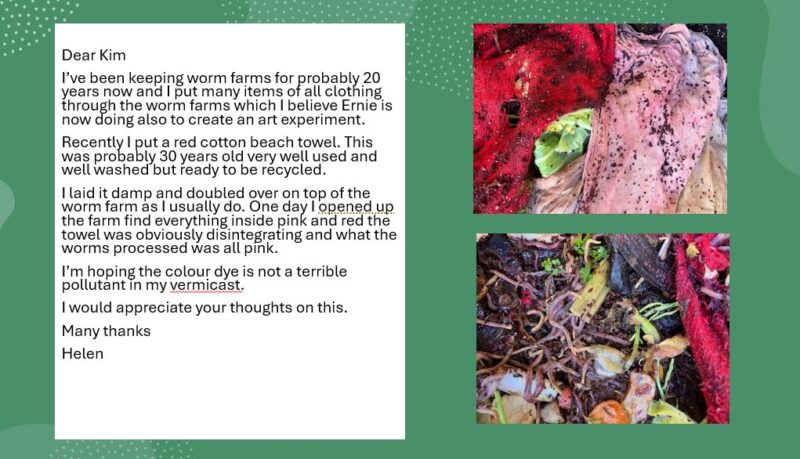
Kim’s answer: I wouldn’t be too concerned as it is most likely a natural dye that leaches out of the material. Probably manufactured in a country that doesn’t utilise synthetic dyes hence the discolouring. The light colour materials in the worm tray also the reason why it stands out a bit more in the photo. To mitigate that I would recommend the addition of more carbon material such as dried grass clippings, hay or straw. Dried leaves work well too.
Worms and heat stress
Zoe asked: How do the worms survive heat stress?
Kim’s answer: Best practice in hotter regions in Australia is to move your wormfarm into full shade and during heatwaves place a sealed solid frozen 2-3 Litre water bottle (milk or juice plastic bottles work well) inside and on top of the worm feed material. Wash after thawing and refreeze again.
Worm cafes
Zoe asked: Does the hungry bin work better than the worm cafe in hot weather? And which one is your favourite system?
Kim’s answer: Both systems work well. I prefer the flow-through hungry bin due to the amount of organics it can process, 1-1.5Kg per day. However, the clip opening design to harvest the castings at the bottom can jam at times.
Kelly asked: re – the sludge at the bottom of the cafe – what’s the best process for working with this sludge?
Kim’s answer: The sludge is just a very refined casting material. I scrape it out and dilute it in a watering can and water it straight around the base of my fruit trees or vegie patch. It can also be added to the other harvested castings and dried a little to mix into potting mixes.
Row worm farms
Roo asked: Can you explain how the pile system works with the front-end loader?
Kim’s answer: I extend the pile by adding the compostable material to one end of the row pile and let the worms migrate into that area naturally after it cooled down from hot composting, leaving behind the wormcastings.
Worms and predators
Caz asked: How do you protect the worms from predation – Bandicoots, rats and possums – especially in the row worm farms?
Kim’s answer: It’s important to monitor vermin activity in the area of your worm farms. Regular attending and turning material helps to disturb those critters from building nests. I also use live traps to check any activity. I also use ample carbon material such as mulches on top of my rows, creating a barrier.
Materials
Caz asked: Thoughts on cardboard and egg cartons?
Kim’s answer: Cardboard and egg cartons are excellent as a carbon input next to dried grass clippings, hay or straw as well as dried leaves. Rip up the cardboard into small-sized pieces and remove all stickers and sticky tape.
Catch our next webinar
If you would like to catch all our upcoming webinars, join LOCCAL (it’s free). You will be notified of all events and receive regular newsletters with updates. Membership – LOCCAL
Leave a Reply