By Ernie Harbott
“No-Waste Composting: Small-Space Waste Recycling, Indoors and Out” by Michelle Balz, 2021
There aren’t many books that would cater to beginner composters which experienced composters would still find a riveting resource, but this book could easily please everyone, from novice to expert. It’s a very enlightened, humorous and well-written book. It’s a quick read (well at least I got through it quickly maybe because I couldn’t put it down) which explains the science behind composting and its vital microorganisms, the basic rules you need to follow to compost successfully, and several different methods to compost (even if you don’t have a backyard!).
I love how Michelle states in very clear terms, some very new science, which is not what you usually get in these how to compost books. She delivers these cutting-edge concepts as if they are commonly accepted and well-known nuggets of information, without pausing for you to question it. Michelle gives very concise descriptions of the complexities of composting. She does a great job of explaining browns and greens, and the significance of actinobacteria.

Michelle also confesses things which we composters all think but keep to ourselves for fear of sounding silly. Like how the process of composting starts an avalanche of personal benefits, how because we love earthworms they love us back, and how what we’re doing when we’re composting is keeping the biology in our bins alive and happy. She makes us believe that when we set aside materials from our waste to create a resource for own backyard, we are actually positively affecting the environment on a global scale, it’s not just wishful thinking.
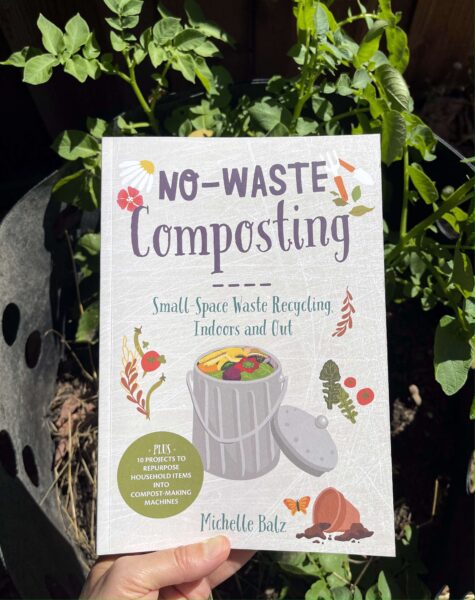
If you’re already a composter this book is endearing. But if you want to start composting, but don’t know where to start, this is it. In addition to providing valuable information about composting, Michelle provides ten detailed composting DIY projects that repurpose household items into compost-making machines. Her projects range from simple items like crafting newspaper liners to neatly wrap up food scraps to creating your own composter from old pickle barrels or trash cans. She also offers several descriptions for larger outdoor composting, complete with space and material requirements and plenty of pictures (which she gratefully acknowledges her family and friends as good sports for posing for them).
One of the best chapters was the one that shared three methods for composting on a balcony, patio or indoor space. I’m always promoting these methods, but as someone with a lot of outdoor space to compost in, I’ve never put them to the test. Michelle has reassured me about indoor vermicomposting, inspired me to try bokashi pre-composting, and surprised me with a method new to me – terracotta composting – which I’m also now eager to try. “New” in composting is not something I come across often. I imagine this book would be fun and fresh to anyone interested in composting.
Leave a Reply